Your business has grown.
Why does everything still need to come through you?
How founders and CEOs can reduce owner dependency, strengthen leadership capability and build a more scalable business.
Scaling a business is not just about increasing revenue or adding more people.
As founder-led businesses grow, the real challenge often becomes leadership capacity, decision-making, accountability and building a business that can perform without everything depending on the owner.
Growth is supposed to create opportunity.
But for many business owners and CEOs, growth does something else first: it creates more decisions, more people, more complexity, more meetings and more things that somehow still need to come through you.
Revenue goes up. The team gets bigger. The business looks more successful from the outside. And yet you feel busier than ever.
That is often the point where a growing business starts to hit a different kind of ceiling — not a sales ceiling, but a leadership and operating-model ceiling.
If the business still depends heavily on you to make decisions, solve problems, approve work and keep everything moving, the business may be growing, but it is not necessarily scaling.
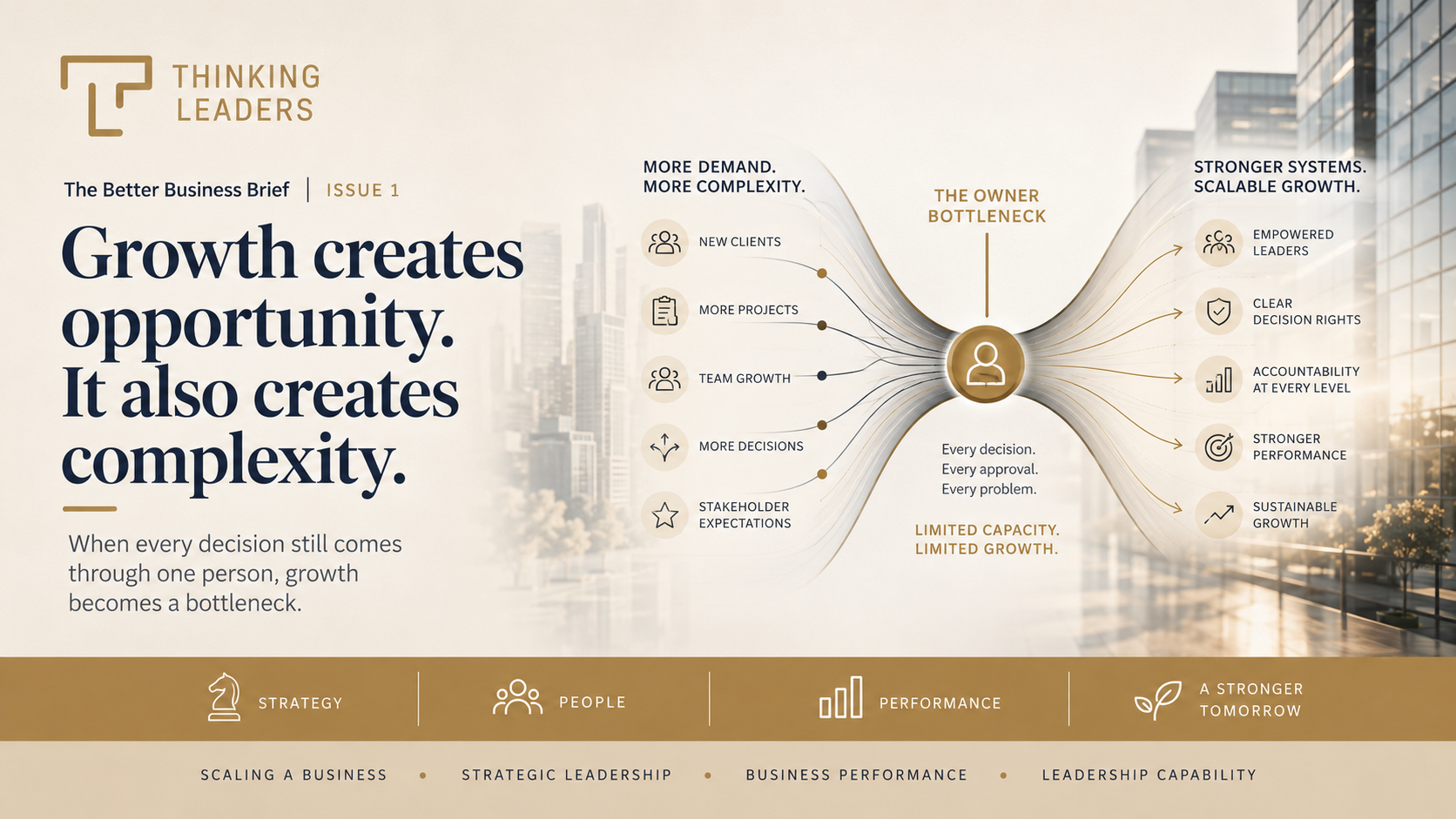
The owner bottleneck
This is one of the most common patterns I see in growing businesses. The founder or CEO is capable, experienced and deeply invested in the business.
Which is exactly why everyone keeps coming back to them.
At first, that works. In a small business, speed often comes from having one person who knows everything and can make decisions quickly.
But as the business grows, the same behaviour that helped build it can start to constrain it.
The signs are usually familiar:
- decisions are delayed because they are waiting for you
- people escalate issues they should be able to solve themselves
- your senior team is busy, but not genuinely accountable
- you spend too much time in operational detail
- priorities shift depending on what lands on your desk
- you are still carrying knowledge that should sit elsewhere in the business
And perhaps the biggest warning sign:
You cannot imagine stepping away from the business for four weeks without something slowing down.
That is not just a lifestyle issue. It is a business-value issue. A business that is heavily dependent on its owner is harder to scale, harder to invest in and often harder to sell.
The answer is not simply “delegate more”
That advice gets thrown around constantly. But telling a business owner to delegate more is a bit like telling someone to exercise more. Technically correct. Not terribly useful.
Good delegation only works when the business has the structure to support it.
That means three things.
1. Clear decision rights
People need to know what they own. Not vaguely. Specifically. What can they decide without approval? What needs consultation? What genuinely needs to come to the CEO? If those boundaries are not clear, capable people will either make decisions they should not — or, more commonly, avoid making decisions at all.
2. Capability, not just capacity
When businesses get busy, the immediate response is often: “We need another person.” Sometimes that is true. But adding headcount does not automatically create capability.
- What work actually needs to be done?
- What capability is missing?
- Is the issue workload, structure, skills or poor process?
- Are senior people spending time on work that should sit lower in the organisation?
- Could better systems remove the need for another role altogether?
Hiring into a messy structure usually just creates a bigger messy structure.
3. A stronger operating rhythm
As a business grows, informal communication stops working. The conversations that used to happen naturally need to become more deliberate. That means clear priorities, useful measures, regular performance conversations and a rhythm for reviewing what matters. Not more meetings. Better meetings.
The goal is simple: people should know what matters, how they are performing and what they are accountable for without the owner having to continually chase it.
The leadership shift
For many owners, this is the hardest part. The business needs you to stop being the person who solves everything.
Your role has to evolve: from doing, to directing, to enabling, to leading performance.
That does not mean becoming detached from the business. It means becoming more intentional about where your involvement creates the most value: strategy, capital allocation, key relationships, culture, leadership capability and future growth.
Those are very different activities from fixing every operational problem.
THREE QUESTIONS WORTH ASKING THIS WEEK… 1. What decisions am I still making that someone else could — and should — own? 2. Where is the business genuinely missing capability, rather than simply feeling busy? 3. If I disappeared for four weeks tomorrow, what would slow down or stop? Your answers will tell you a lot about where the business needs to mature next. |
Because growth is not just about getting bigger.
It is about building a business that becomes stronger, more capable and less dependent on any one person as it grows.
And that is ultimately what creates a more valuable business.
Welcome to The Better Business Brief
Each edition, I’ll explore the decisions that sit at the intersection of strategy, people and performance — and what they mean for businesses navigating growth, investment, succession and exit.
What’s one decision you’re still making that someone else in your business should own? Tell me in the comments — your answer may reveal exactly where the next bottleneck is sitting.
Linda Scott
Business Advisor | Strategic CFO | Leadership Consultant
Thinking Leaders