The Better Business Brief — Issue 2
Your Business Is Growing. But Is It Actually Scaling?
Growth is usually celebrated.
More revenue. More customers. More people. More opportunity.
All positive signs.
But growth can also create a problem that is much harder to see from the outside.
The business gets bigger, but not necessarily stronger.
The owner becomes busier. The leadership team becomes stretched. Costs rise. Decisions slow down. More people are added, but accountability does not improve.
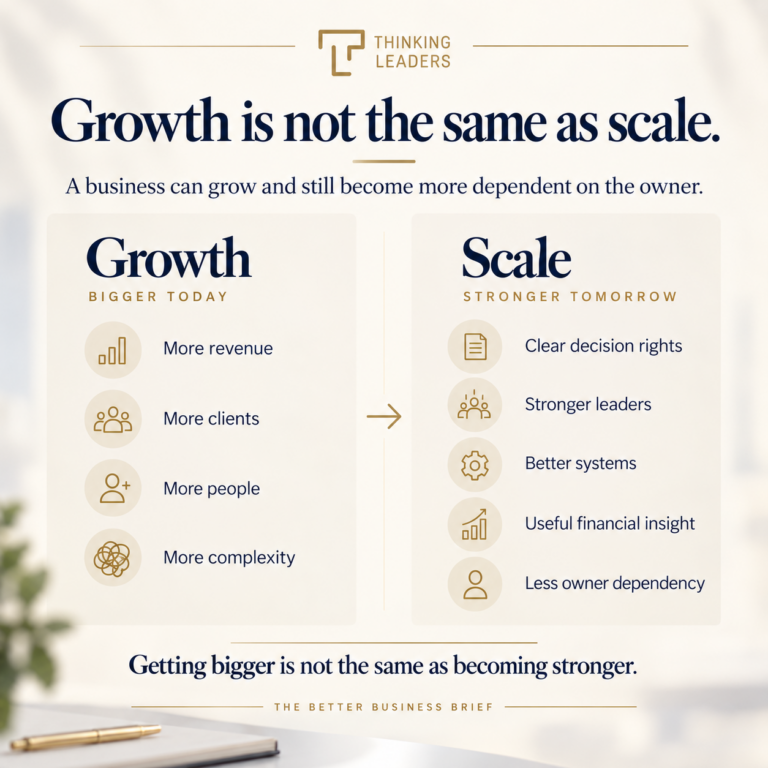
That is the difference between growth and scale.
A business can grow quickly and still become more dependent on the owner, more complex to run and less profitable underneath the surface.
Scaling is different.
Scaling means the business can handle more revenue, more customers and more complexity without increasing dependency at the same rate.
That requires more than ambition.
It requires stronger systems, stronger leaders, better financial visibility and clearer accountability.

Growth can hide a lot
One of the risks in a growing business is that revenue becomes the headline measure.
And revenue matters.
But it does not tell you whether the business is becoming more valuable, more resilient or easier to run.
A business can increase revenue while:
- gross margin deteriorates
- overhead grows faster than sales
- cash gets tied up in working capital
- the owner becomes the default decision-maker
- customer concentration increases
- leadership capability falls behind complexity
- new roles are added without clear accountability
- systems and processes fail to keep pace
On paper, the business is growing.
Operationally, it may be getting harder to manage.
Commercially, it may actually be getting weaker.
1. Revenue is growing faster than profit
Growth can feel successful while the economics quietly worsen.
This often happens when a business adds people, infrastructure and overhead ahead of capability, pricing discipline or productivity.
Revenue rises.
But margin comes under pressure.
Then the business has to grow even faster just to maintain the same level of profit.
That is not scale.
That is treadmill growth.
As a business grows, leaders need to understand:
- which customers are actually profitable
- which services or products create the best margin
- where delivery costs are increasing
- whether pricing reflects the real cost to serve
- whether overhead is growing proportionately
- whether productivity is improving
The top line tells you whether the business is getting bigger.
The numbers underneath tell you whether it is getting better.
2. The owner is still the bottleneck
This is one of the clearest signs that growth has not yet translated into scale.
The business may have more people and more management layers, but important decisions still come back to the owner or CEO.
- Pricing
- Hiring
- Client issues
- Spending
- Operational problems
- People problems
- Strategy
When too much still depends on one person, the business has not genuinely built capacity around that leader.
That creates risk.
It slows decisions, limits leadership growth and makes the business harder to scale, invest in or eventually sell.
The question is not simply:
“How much has the business grown?”
A better question is:
“How much of the business can now operate well without me?”
That tells you far more about scale.
3. Cash is being consumed by growth
Profitable businesses can still run out of cash.
Growth often increases the amount of money tied up in the business.
- More inventory
- More debtors
- More employees
- More equipment
- More upfront delivery costs
- Longer customer payment cycles
A business can be profitable on paper while cash gets tighter every month.
This is why growing businesses need stronger forecasting and working-capital discipline.
The question is not just:
“Are we profitable?”
It is also:
“How much cash does this growth require?”
If the leadership team cannot answer that with confidence, growth can become a financial risk rather than an opportunity.
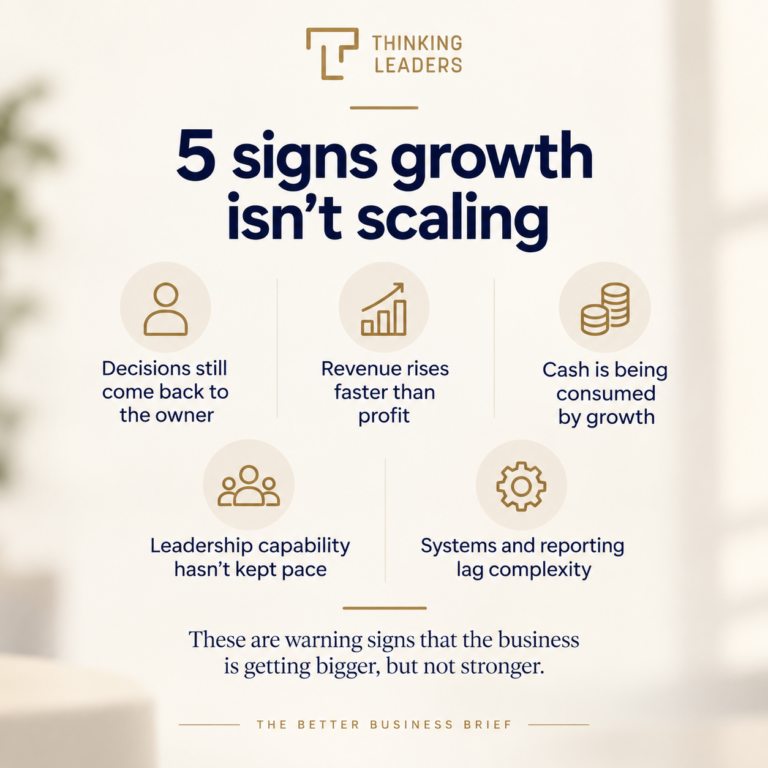
4. Leadership capability has not kept pace
A team that worked well at $2 million in revenue may not be the team structure required at $10 million.
As complexity grows, the leadership capability required changes too.
The business needs people who can:
- make sound decisions independently
- lead others
- manage performance
- challenge assumptions
- think commercially
- operate across functions
- hold accountability
This is where many businesses hit a ceiling.
The owner has grown the business faster than the leadership capability beneath them.
The response is often to hire more people.
But adding headcount does not automatically solve a capability problem.
Before recruiting, ask:
What capability does the business actually need at the next stage?
That is a very different question from:
Who can we hire to reduce the workload?
5. The operating model has not grown up
Small businesses can operate effectively through informal communication.
People know what is happening because they sit near each other, talk constantly and rely on the owner to connect the dots.
As the business grows, that stops working.
The organisation needs more deliberate operating disciplines.
- Clear priorities
- Defined decision rights
- Useful KPIs
- Regular performance conversations
- Better management reporting
- Clearer role accountability
- Consistent meeting rhythms
Not bureaucracy for the sake of it.
Just enough structure to support complexity.
This is where professionalisation matters.
Without it, growth creates noise.
With it, growth creates leverage.
6. The financial information is too backward-looking
Many businesses have financial reporting.
Far fewer have financial insight.
There is a big difference.
Reporting tells you:
What happened?
Useful financial leadership helps you understand:
- Why did it happen?
- What is changing?
- What happens next?
- What decision should we make now?
As businesses scale, leaders need more than historical accounts.
They need visibility over:
- cash flow
- margins
- customer profitability
- cost trends
- productivity
- working capital
- forecast performance
- investment requirements
- scenario impacts
This is where a Strategic CFO becomes valuable.
Not because the business needs more reports.
Because the leadership team needs better decisions.
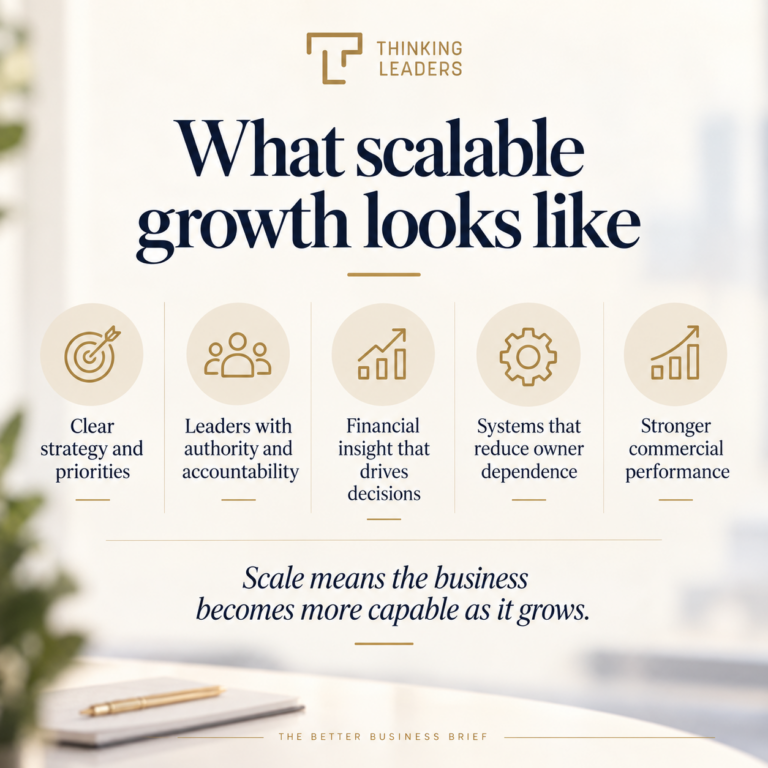
So, what does scalable growth actually look like?
A scalable business is not one where the owner disappears.
It is one where the business becomes less dependent on that person as it grows.
That means:
Strategy is clear enough for others to execute.
Leaders have genuine authority and accountability.
Financial information supports decisions, not just compliance.
Systems and processes carry knowledge that once lived in people’s heads.
Performance can be measured without constant intervention.
The organisation can absorb complexity without everything becoming harder.
And importantly:
the owner’s role becomes more strategic as the business becomes more capable.
That is scale.

Three questions worth asking this week
- Where has complexity increased faster than capability in our business?
- What has grown faster over the past 12 months: revenue, profit or overhead?
- If we doubled revenue over the next three years, what would break first?
Those answers will tell you a lot about whether your business is simply getting bigger — or genuinely becoming stronger.
Because the goal is not growth at any cost.
It is to build a business that can grow with greater discipline, stronger leadership and better commercial performance.
That is what creates a scalable business.
And ultimately, a more valuable one.
Welcome to The Better Business Brief
The Better Business Brief explores the decisions that sit at the intersection of strategy, people and performance…
and what they mean for businesses navigating growth, investment, succession and exit.